What would I choose, even if no one understood?
Sometimes you want something before you can explain it.
The feeling can be clear while the answer is not. Someone asks why you want to do it, what the plan is, or what you will get from it, and you try to defend a private feeling with evidence, as if your life needs a presentation. “I do not know yet” may be the most honest answer, even if it is rarely the one people find satisfying.
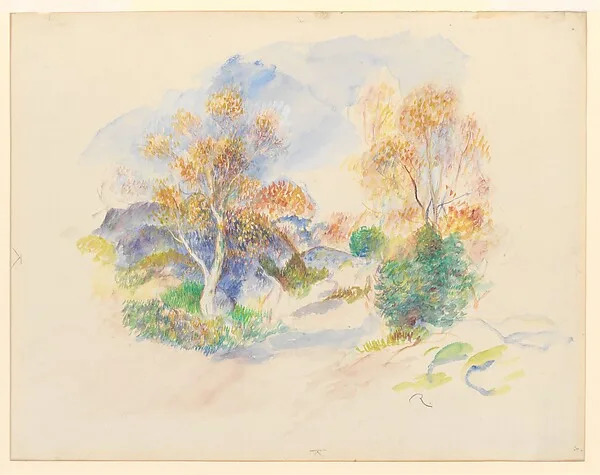
In Landscape with a Path between Trees , the path shows the next few steps, not the destination. Trees gather around it, and the ground opens just enough to invite movement while the end stays hidden by color and distance. Many real choices feel this way. You can see what comes next, but not where it will finally lead.
Most people prefer a visible destination because it is easier to approve. A better title makes sense. A degree makes sense. A bigger house, a sensible relationship, or a profitable project arrives with a label already attached. Some of the things that matter most begin without a convincing label.
You may want to make something, spend more time outside, move closer to someone you love, stop pretending a certain version of your life still fits, or learn a skill simply because it keeps returning to your attention. None of these desires is automatically wise. A private pull is not a guarantee, and it is not a command to abandon your responsibilities. It is information.
The cost of needing a good explanation is that you stop asking what you want and start asking what you can explain successfully. A private decision becomes a public performance. You say the change will improve your career, the move makes financial sense, or the project has long-term potential. Those things may all be true.
Underneath them, there may be another truth: you feel more like yourself when you imagine going this way. That sentence is not a business plan. It does not answer every practical question. It may still be the most honest sentence in the room.
Honest does not always mean easy. Sometimes it feels selfish, boring, or disappointing to people who were certain they knew what you should do. It may mean saying no to an opportunity everyone else calls lucky or staying with a slow project instead of chasing the louder one. Advice can be useful, but advice is not permission.
This does not mean ignoring the people who love you. You can listen carefully without handing someone else the steering wheel. A private pull is not a final answer. The thing you want today may not be the thing you want forever, and changing direction is not always failure.
You can choose carefully without pretending to know everything. You can take the next honest step, protect your essential responsibilities, and see what the path teaches you. A small beginning is still a beginning.
Notice what keeps returning. It may be the idea that appears while you are washing dishes, the person you want to call, or the work you do after everyone else has gone to bed. Repeated attention does not prove that you should act immediately, but it may show where some part of you is still awake.
Ask what you would still choose if nobody praised you for it. Notice what you are explaining too much. Notice which direction makes you feel more honest, even if it makes you less impressive.
There will be choices no one around you understands. Some things become understandable only after you have lived them. You do not have to force the whole explanation out before you begin. There is a quiet dignity in walking without an audience, in being thoughtful and cautious, paying the bills, and still choosing a road no one else would have picked for you.
Maybe the question is not whether you can prove the path is right. Maybe it is whether you can stop pretending you do not see it.
What direction do you keep looking toward, even when you have no good explanation for it?