What is my attention turning me into?
What we keep looking at becomes easier to find.
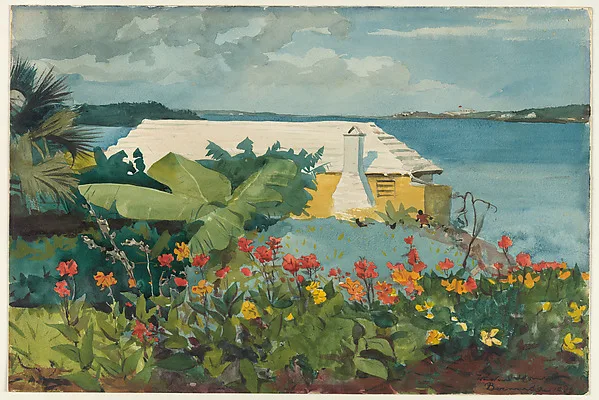
In Winslow Homer’s Flower Garden and Bungalow, Bermuda , a bright home sits behind a thick garden. The bungalow is visible, but the flowers hold the eye first. They fill the foreground with greens, reds, yellows, and shadow, as if the house were surrounded by whatever someone kept watering.
The painting makes attention feel less like a productivity trick and more like a place we live inside. What we return to begins to shape the rooms of that place, even when the choices feel small at first. We check some things every few minutes. We feed certain conversations, practise particular skills, and worry about the same problems from slightly different angles.
Then those choices become a path. If you keep checking for criticism, you may become very good at finding it. What you notice often becomes what you notice next.
Attention is not the same as optimism, and hard things still need care. A sick family member needs care. Bills need opening. Bad news may require action. But a problem can deserve attention without occupying every room, and you can admit that the weather is bad without deciding that the whole season is ruined.
The bungalow in Homer’s painting is not separate from the garden or the weather around it. The house sits inside an environment. So do we.
Every garden has weather it did not order. There are storms, dry spells, and weeks when nothing seems to grow. Care does not control any of that, but it gives us a way to remain in relationship with what is living.
Some parts of our inner landscape grow because we chose them. Other parts grow because they are loud. Notifications are loud. Outrage is loud. Comparison is loud. Sometimes checking helps. Sometimes it is only a habit wearing a little safety vest.
Attention is a quiet way to shape a life. Something will always get the morning hour, receive the unhurried conversation, or become the subject you return to when the room goes quiet. That does not make everything else unimportant. It means attention is one of the plain ways a life takes its form.
A garden does not need every plant to bloom at once. One small patch does not need the whole garden rebuilt. You can choose one small patch: check your phone after checking in with yourself, give one person your full attention, or spend ten quiet minutes on something you want to grow.
These are not rules. They are small acts of cultivation.
In Homer’s painting, the bungalow is not an escape from the world. It is a home surrounded by weather, flowers, distance, and light. Our attention does something similar. It creates the atmosphere in which our days happen. You are not only paying attention. You are making a place.
Winslow Homer, Flower Garden and Bungalow, Bermuda, 1899, watercolor and graphite, The Metropolitan Museum of Art, Open Access. View the artwork at The Metropolitan Museum of Art .
This week, what are you watering?